AIDN’s core ethos is ‘more’ and ‘better’ global giving and we seek to foster an environment for the discussion and exploration of how we define these terms in an ever-changing international development ecosystem. Alongside our events, webinars and resources, The AIDN Beat is a key way to achieve this goal.  The AIDN Beat strives to keep up with the rhythm of the international development sector and cover a broad range of subjects: from innovative development financing, to leading case-studies of programs on-the-ground, to the need for a genuine commitment to localisation.

We are also deeply committed to amplifying diverse voices. Consequently, we accept submissions to The AIDN Beat – so that our dynamic network can shape the discussion too. If you would like to submit content for The AIDN Beat, then we would love to hear from you. Get in touch with us (via hannah@aidnetwork.org.au) and we will share our editorial guidelines.


Subscribers of The AIDN Beat will receive a bi-monthly email where we’ll share recent pieces from The AIDN Beat, alongside curated pieces from other international development platforms and provide a recommendation for a relevant text, film or podcast.

If you’re are not currently signed up to receive The AIDN Beat or our newsletter, you can do so by filling in the form below.

Sign Up

to receive the latest AIDN news to your inbox

NEWS & RESOURCES

Latest Stories and Developments
A further expansion of the Global Gag Rule: An affront to reproductive rights globally.

A further expansion of the Global Gag Rule: An affront to reproductive rights globally.

Grishma Bista, Chief Executive Officer of MSI Asia Pacific, provides our network with the latest update on the expansion of the 'global gag rule'. While the policy was historically focused on abortion,  it has now expanded to restrict 'gender ideology' and any efforts to promote diversity, equity and inclusion (DEI).  With particularly devastating impacts on women in the Majority World, MSI is calling on the sector to push back on this war on reproductive rights.
Who pays for climate adaptation in Northern Kenya?

Who pays for climate adaptation in Northern Kenya?

Hadija Bonaya, development practitioner and Atlantic Fellow for Social and Economic Equity at the LSE, explores how climate adaptation in Northern Kenya is increasingly funded though projects and consultancies rather than through everyday services. In turn, this shifts the real cost of climate change onto low-income pastoralist communities, especially women, while the global climate finance system continues to reward institutions more than resilience.
Are founders the new funders? The case of the 1000 Days Fund and Black Licorice.

Are founders the new funders? The case of the 1000 Days Fund and Black Licorice.

Zack Petersen, Founder of Black Licorice and the 1000 Days Fund, argues that traditional funding mechanisms often overlook early-stage, locally rooted nonprofit founders. "Black Licorice" is challenging this model and instead proposes a “founders-as-funders” approach whereby experienced NFP leaders seed emerging organisations within their ecosystem. In the case of Black Licorice, the goal is to form Indonesia’s first tight-knit ecosystem of maternal health innovators: a peer-driven network capable of influencing national systems and donor priorities.
No results found.
AIDN’s 2025 Summer Listening List

AIDN’s 2025 Summer Listening List

AIDN has compiled our international development, philanthropy and global issues themed "Summer Listening List" for 2025 - based on 2025 Philanthropod seasons. We've grouped the episodes into broad themes to pique your interest….
Climate change does not cause land conflict; it exacerbates it: Latest research insights on land governance from Nigeria, Somaliland, South Sudan, Sudan, and Chad.

Climate change does not cause land conflict; it exacerbates it: Latest research insights on land governance from Nigeria, Somaliland, South Sudan, Sudan, and Chad.

Elizabeth Daley serves as the Chair of the Board of the Land Portal Foundation and has worked as an independent consultant on land tenure, gender equity and social inclusion for over 20 years globally. She worked on FCDO’s SPARC programme from August 2024 to October 2025. In this piece, Elizabeth shares insights from the latest global research on the intersection of pastoral land governance, climate change and gender.
AIDN Beat Spotlight – Sumana Deni

AIDN Beat Spotlight – Sumana Deni

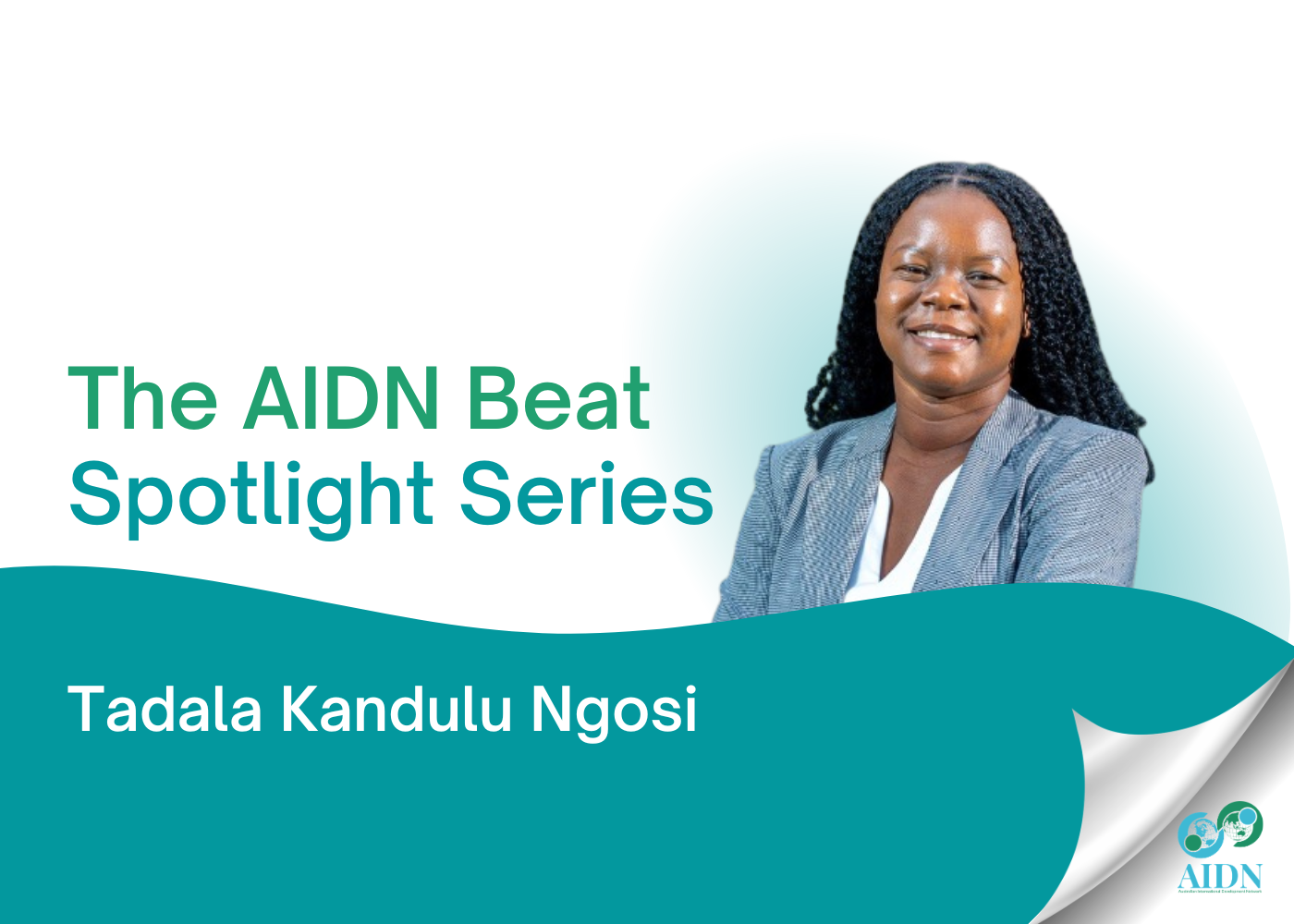
Through The AIDN Beat Spotlight series we hope to highlight a diverse range of sector experts and learn more about their journey in the international development sector. Meet Sumana Deni: Waste to Wealth and Community Engagement Coordinator with Positive Change for Marine Life in Gizo, Solomon Islands.
Unlocking diaspora giving: A new wave of philanthropists.

Unlocking diaspora giving: A new wave of philanthropists.

With growing research underscoring the power of diaspora giving, Anita Toy, Founding Executive Director of Myriad Australia, argues it’s time to build the philanthropic structures needed to harness this major source of giving for sustained, high-impact change. It's also time to recognise migrants and diaspora communities as key contributors to global development alongside foundations and major donors.
Global aid cuts are the perfect time to move towards a model of refugee empowerment.

Global aid cuts are the perfect time to move towards a model of refugee empowerment.

Caitlin McCaffrie, Policy Director for Forced Migration at the Centre for Policy Development, provides unique insight into The 2025 Asia Dialogue on Forced Migration (ADFM). This year's ADFM underscored both crisis and opportunity for the global refugee system. On one hand, severe funding cuts. On the other, new policy shifts in Thailand suggest more sustainable, rights-based solutions in the region.
AIDN Beat Spotlight – Edward Ssempewo

AIDN Beat Spotlight – Edward Ssempewo

Through The AIDN Beat Spotlight series we hope to highlight a diverse range of sector experts and learn more about their journey in the international development sector. Meet Ssempewo Edward: advocate of the High Court of Uganda, systems leader, early-career researcher and, Founder and Executive Director of Rescue Mission for Street Life (RMFSL).
Stop buying sunshine: The 10% stake every donor should take to ending stunting in Indonesia.

Stop buying sunshine: The 10% stake every donor should take to ending stunting in Indonesia.

Too often in international development one-and-done interventions parachute in from afar. But for Zack Peterson, Founder and Chief Strategist of the 1000 Days Fund, donors need to start seeing themselves as a shareholder with a 10% stake in the organisations they are funding. If donors want impact, there are no shortcuts: professionalise the workforce, lock in policy, measure what actually matters, and give enough time for real change. Anything else is buying sunshine.
Crises are complex. But we can cut through the noise and act.

Crises are complex. But we can cut through the noise and act.

Attention is a fickle, finite resource. Once a crisis becomes too intractable – we no longer hear about it. However, for Tamar Kosky Lazarus (Chief Development and Communications Officer at IsraAID), these seemingly intractable crises are often made up of problems that aren’t complicated at all. They’re painfully, insultingly solvable. While we’re fatigued by the terrifying big picture, we miss what can be done.
Financial inclusion in 2025 – time for a health check.

Financial inclusion in 2025 – time for a health check.

Clay O'Brien, experienced financial inclusion, microfinance and international development advisor, analyses the World Bank's fifth edition of its Global Findex Database for our network. Clay highlights the need for ongoing work from national regulators and international organisations to promote inclusive financial and banking policies, to consider gender gaps in access to fintech, and to work to address the specific needs of low-income and disadvantaged communities in their access and use of financial products.
No results found.