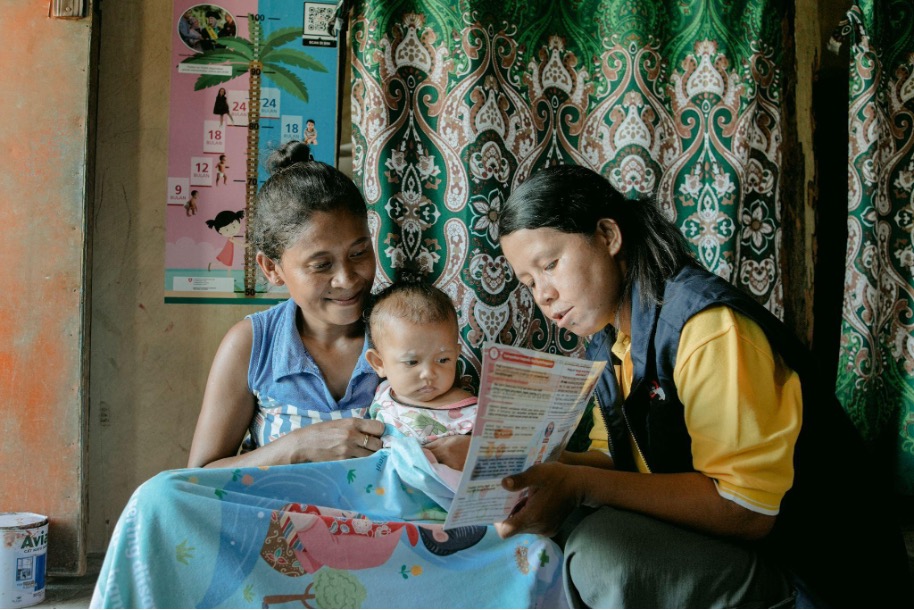
On a humid morning in Manggarai Barat, a mother stands beneath the eaves of a crowded village health post, her youngest child on her hip and a faded growth card clutched in her hand. For years, the promises were familiar and the outcomes unchanged: too many children growing too slowly, too many families told to “eat better” in places where markets are distant, protein is costly, and time is scarce. Then, between 2021 and 2024, something shifted. Not a new hospital. Not a new device. A familiar face began knocking on doors with something far more radical: time, attention, and trust.
A quiet experiment in two rural districts
East Nusa Tenggara is one of Indonesia’s poorest provinces and among its hungriest. When the 1000 Days Fund began work in Manggarai Barat and Rote Ndao, roughly 1 in 3 children were stunted. Indonesia relies on an army of volunteer community health workers (CHWs) to carry care into villages where paved roads do not reach—yet fewer than 15 % receive formal training before they begin. The bet was simple and bold: equip CHWs with practical tools, close mentoring, and visible backing from clinics and local government, focus relentlessly on the first 1,000 days of life, and child growth will improve faster and more fairly than national trends suggest.
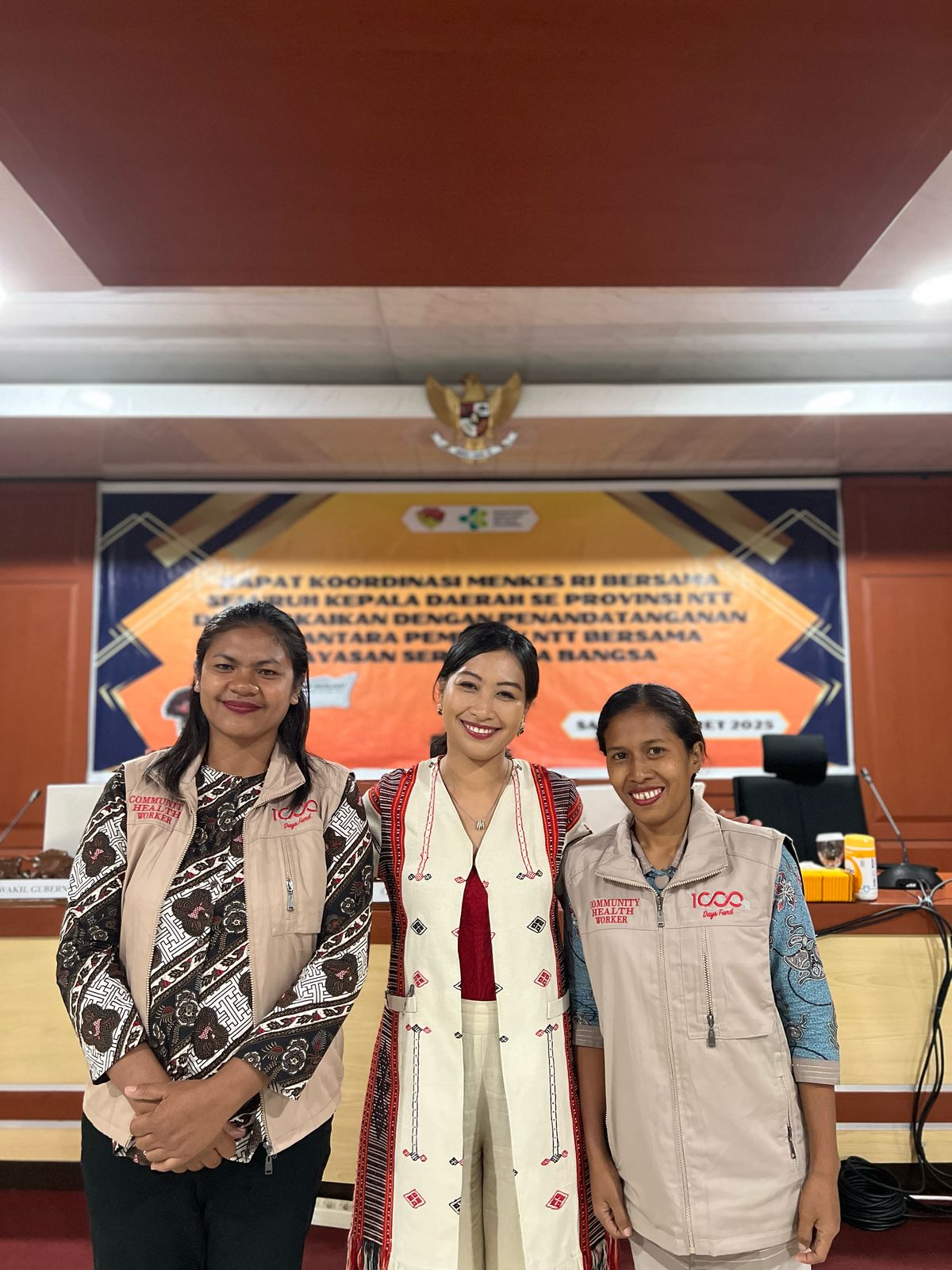
MoU signing ceremony between the East Nusa Tenggara Provincial Government and 1000 Days Fund.
To test that bet, we undertook an independent mixed‑methods evaluation, built around contribution analysis rather than randomised trials, pulled together routine program monitoring, district and national survey data, and completed an independent implementation study led by the Behavioural Insights Team. Researchers asked a deceptively simple question: is the pattern of change in these two districts plausibly linked to what CHWs are doing, or could it just be statistical noise?
Three years later, the numbers tell a story that is hard to ignore. Stunting prevalence in Manggarai Barat and Rote Ndao fell by 19%—a 7.5 percentage-point drop in each district—outperforming 18 of the 22 other districts in East Nusa Tenggara. Beneath that headline, everyday practices inside homes also began to look different. Adherence to iron and folic acid supplements during pregnancy climbed to 72%, far above the national figure of 43%. Basic immunisation coverage for young children hit 73%—almost double Indonesia’s 36 percent national rate for the same indicators. CHWs themselves changed, too. Knowledge scores after training rose by 32%. The sharpest gains came in 2023–2024, after years of steady engagement, reinforcing a familiar truth: Systems don’t change overnight, but when they do change, the effects compound.
Trust as an indicator for impact
However, it was one finding that stood out in particular: the critical role of trust in maximising the impact of our CHWs. On paper, the model looks technical: structured training on stunting and nutrition, a “Smart Chart” to track growth and key practices, and regular mentoring visits. CHWs work through existing infrastructure—village health posts and community health centres—strengthening the public system rather than replacing it.
But the Behavioural Insights Team’s evaluation also revealed something less tangible and more powerful. The real driver of change was not the chart on the wall. It was trust at the door.
The most effective CHWs did not simply recite messages more often; they listened longer. They respected local norms, navigated delicate family politics, and quietly solved problems that mattered to each household, from arranging transport to a clinic to mediating with sceptical in‑laws. Frequency of visits mattered only insofar as it allowed relationships to deepen. In some communities, the visible backing of a nurse, midwife, or village head unlocked that trust; in others, especially remote hamlets, it was the CHW’s consistent presence and empathy that made the difference.
This experience and these results were decisive and led to us subtly rewriting our programme’s theory of change. Instead of a linear chain—train CHWs → deliver messages → change behaviours → reduce stunting—the evaluation suggested a more human path. In turn, the model became: train and support CHWs → build trust → tailor support to each family’s reality → shift a cluster of protective behaviours.
Trust, in other words, is now not a pleasant side effect; it is the intervention.
Moving forward
The results of our mixed-methods evaluation do not claim neat, singular causation; in a living health system, no actor works alone. But when government statistics, program data, and village‑level stories all point in the same direction, a plausible picture emerges: CHWs who are trained, supported, and trusted can move indicators that once looked immovable.
For philanthropists and governments deciding where to put scarce resources, but also for our fellow NGOs that rely on the hard work of CHWs, three practical lessons emerge.
- Invest in people and relationships, not only commodities and campaigns: skilled, supervised, and socially embedded CHWs can shift stubborn indicators.
- Design scale‑up around capability and learning, with stronger data pipelines, routine supervision embedded in local and district budgets, and a culture of continuous adaptation and reflection instead of one‑off pilots.
- Support the ongoing work of your fellow sector partners and NGOs, such as Community Health Impact Coalition in our case, who are advocating for the much-needed training, professionalisation and recognition of community health workers worldwide.

Dr. Rindang Asmara Petersen, M.D., is the CEO of the 1000 Days Fund and a physician and global health policy specialist who has built her career at the intersection of frontline care and systems change. She leads the organisation’s strategy to end child stunting in Indonesia by equipping trained, confident community health workers to deliver high‑impact support to mothers and children in the first 1,000 days of life.
Prior to joining the 1000 Days Fund, Riri served as the liaison between the Mayo Clinic and the Government of Indonesia, helping to bridge world‑class clinical expertise with national health priorities. She was the General Manager of BIMC Hospital Nusa Dua Bali from 2017 to 2020, where she championed patient‑centered care, strengthened clinical governance, and built partnerships that improved access and quality for Indonesian families.
Feature image: A Community Health Worker on outreach through The 1000 Days Fund’s 6 Plus 6 model.