Education ministries in small, aid-dependent nations are rarely short of partners. Bilateral agencies, multilateral institutions, international and local NGOs, and an increasing number of philanthropic funders are typically all active in the same system, often supporting similar goals through separate initiatives. For a ministry with limited staff and a constrained budget, this can be a genuine asset, but it also presents a coordination challenge. Where engagement is not well aligned, even well-resourced systems can find it difficult to absorb, sequence and sustain multiple parallel initiatives.
This is not a reflection of any shortcoming in government capability. It is, rather, a structural feature of small education systems operating in crowded development landscapes, one that we believe philanthropy has a particular responsibility to help address. Where funders design and deliver support without sufficient coordination with one another, or full alignment with government priorities, the result can be a series of valuable but disconnected initiatives, rather than a strengthened, sustainable system.
Philanthropy also has a responsibility to distinguish between well-intentioned gifts and genuine partnership. Many of the most visible forms of support to education systems, such as donated resources or one-off contributions, are easy to deliver and to measure, and can make an important contribution. However, on their own, they are less likely to shift outcomes at a system level. As a philanthropic collective, comprising Octava Foundation and =Dreams Asia, we see our role in Timor-Leste as something different: helping the government identify and pursue its own long-term priorities, with philanthropic capital used to support that agenda rather than to define it.
Over the past eighteen months, our organisations have worked together as the Education Collective for Timor-Leste, to explore what this kind of partnership could look like in practice. Timor-Leste has a highly engaged Ministry of Education with clear ambitions for its education system, alongside a complex operating environment shaped by limited fiscal and human resources and a crowded development landscape.
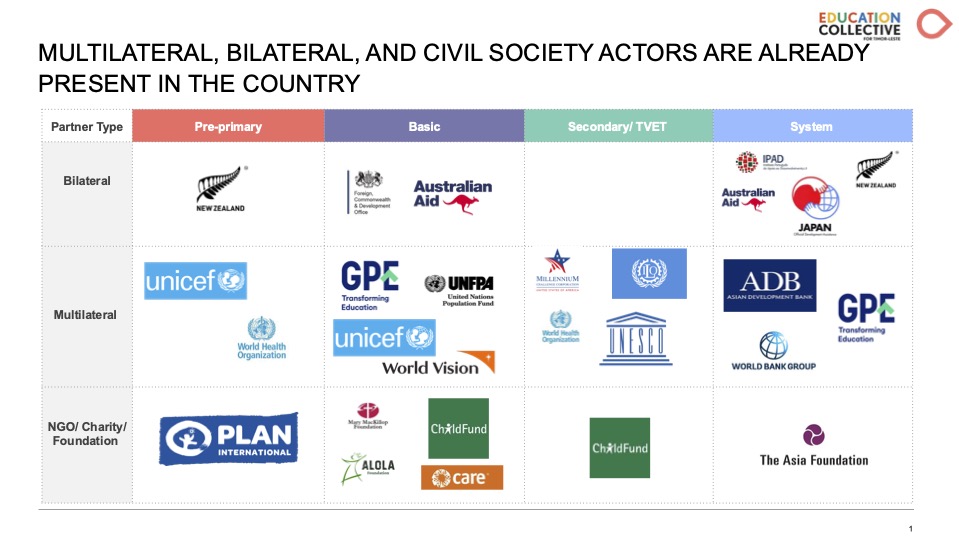
Caption: The crowded education development landscape in Timor-Leste identified in the Education Collective’s report “Collective Philanthropy in Timor-Leste: Actions and Insights”
The scale of the opportunity for investment is significant. Multi-dimensional poverty affects over 40 percent of the population, and the country ranks 155th out of 193 on the Human Development Index (World Bank, 2024; OPHI, 2024). Learning outcomes remain an area of national focus: an Early Grade Reading Assessment found that 70 percent of young children were unable to read a single word of a simple passage (World Bank, 2015), and more recent national exam data show pass rates of 11 percent in mathematics and 20 percent in Portuguese at Grade 12 (National Curriculum Unit – Timor-Leste, 20241). Early childhood education enrolment currently stands at 23 percent, against the Ministry’s own ambitious target of 60 percent by 2028 (MoE, 20222), and the Ministry has identified 511 schools, comprising 1,725 classrooms, in need of reconstruction or major rehabilitation (MoE, 20253).
 These are the same kinds of challenges faced by many fragile and post-conflict education systems rebuilding after significant disruption to their teaching workforce and institutions. What we would highlight is the approach taken in response. Our organisations working as a collective commissioned an eight-month landscaping study in 2025, drawing on more than 50 documents and over 30 stakeholder interviews, together with a field visit, to understand the Ministry’s own priorities and the wider partner landscape before proposing any programme of support. Rather than beginning with a funding offer, we used our first year of engagement to build a relationship of trust with the Ministry, including through technical support to its second National Early Childhood Education Conference in September 2025, which brought together over 200 participants and concluded with a signed Declaration of Commitments. We found that this kind of responsive, low-cost support, offered without a fixed agenda, did more to establish a productive working relationship than a larger financial commitment might have at that early stage. It also confirmed our view that meaningful partnership takes time: priorities that seemed clear in an initial conversation were, quite reasonably, refined as trust deepened and the relationship matured, in the way that any new partnership evolves through ongoing dialogue.
This experience has led us to three principles relevant to funders considering similar partnerships elsewhere:
– Ground investment decisions in evidence,
– Work in close and genuine partnership with government and the wider education ecosystem, and
– Use philanthropic capital catalytically to support early-stage, higher-risk work that larger and less flexible funding mechanisms cannot easily accommodate.
In practice, since the start of the study, for us this has meant extending our support for a mother-tongue literacy approach, building on the evidence base of an existing program planning to scale (the EMULI programme), in a context where a substantial proportion of children begin school speaking neither of the country’s official languages (MoE Education Sector Plan, 2020-24). It has also meant exploring prototype, climate-resilient school construction models that government can affordably build and replicate at scale, supporting the MoE with technical assistance to develop a minimum standard curriculum framework for use in alternative ECE provision, and mapping carefully where other partners, including DFAT’s support to the ALMA teacher mentoring programme, the New Zealand-funded HANDS programme, and the Global Partnership for Education’s system capacity grant, are already active, so that new investment complements rather than duplicates existing efforts.
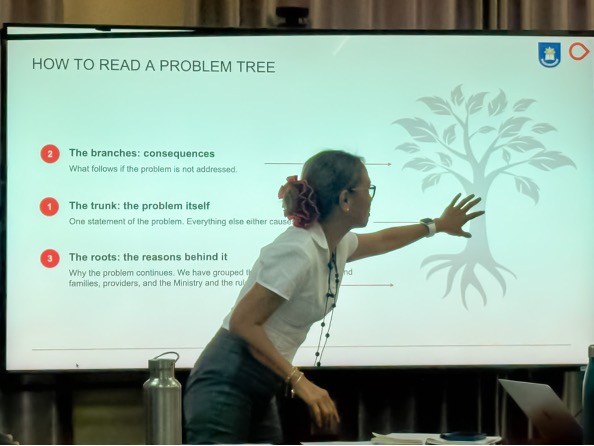 The wider lesson we would draw for our sector extends well beyond Timor-Leste. In any context where government capacity is constrained and the development partner landscape is active, philanthropy is well placed to take a longer-term, more patient approach than many other forms of funding allow. This means resisting the instinct to arrive with a ready-made solution, however well-evidenced, and instead investing time in helping the government lead the process of setting its own priorities, leading solutions they recognise will work in their context, and coordinating support around them. It also means recognising that trust between funder and government must be built over time through consistent, respectful engagement, rather than assumed from the outset.
The broader case for sustained investment in education is well established. Every dollar invested in education and youth skills in developing countries is estimated to generate ten to fifteen dollars in economic growth, and each additional year of schooling is associated with an increase in hourly earnings of around nine percent (UNESCO Global Monitoring Report, 2012; World Bank, 2024). At a time when global education funding is becoming more volatile, including the withdrawal of USAID support that has affected a secondary teacher development programme in Timor-Leste, we believe the case for a coordinated, government-led and patient model of philanthropic partnership has never been stronger.
Article by the Education Collective for Timor Leste, a partnership between =Dreams Asia and Octava Foundation, supported by Better Purpose. Photo credits: Julie Bélanger, Director and Early Years Lead, Better Purpose.
 Cate Noble is co-founder and CEO of Better Purpose, a boutique consultancy that helps education organisations deliver on their purpose. She has previously served as CEO of the Varkey Foundation and a Director at PwC, and has advised philanthropic foundations including Octava Foundation, =Dreams Asia, Gates, Jacobs, and Lego. She recently led the landscaping review for =Dreams Asia that informed the formation of the Education Collective for Timor-Leste.
 Raman Sidhu is CEO of Octava Foundation, and Lead of the Education Collective for Timor-Leste. Raman is the current chair of International Education Funders Group’s steering committee, as well as holds Board roles at a few education NGOs. She has spent the past 15 years in venture philanthropy, working with philanthropists, foundations, impact investors, and social purpose organisations to drive impact in Education. At Octava Foundation, she stewards philanthropic investments across Singapore and the Asia region, with a focus on social innovation in education, mental wellbeing, student
Fiona Hamilton is Country Director for =Dreams Asia in Timor-Leste, and Country Director for the Education Collective for Timor-Leste. She has worked in Timor-Leste for over twenty-five years, across multilateral, bilateral, and community-based organisations, and brings this experience to the Collective’s work supporting the Ministry of Education’s priorities.
Better Purpose shapes and accelerates the work of organisations that want to make a difference to education outcomes all over the world. As an experienced, education-focused consultancy, it provides support with strategy, policy and the design and delivery of education initiatives. Its client base spans government, philanthropy, private sector and non-profit, developing and strengthening educational organisations and initiatives all around the world, including in the UK, US, Middle East, North Africa, sub-Saharan Africa, India, Latin America and Southeast Asia.
Octava Foundation is a Singapore-based private grantmaker committed to building a more inclusive future through equitable education and skills development for our young. The Foundation’s work lies in two interconnected tracks: enabling equitable quality education and ensuring early promotion of mental wellbeing. While Singapore is Octava’s home and primary focus, the Foundation also supports country-led initiatives in Southeast Asia—recognizing that inequities extend beyond national borders. We partner with organizations reimagining what’s possible—who integrate solutions into the system to affect the status quo. Beyond grant capital, we offer management and technical support to help our partners grow stronger, deepen their impact, and bring lasting change to the communities they serve.
=Dreams Asia is a Singapore-based charitable foundation focused on child development and poverty reduction across Asia. Founded in 2010, the foundation has supported communities in Timor-Leste, Cambodia, China, and elsewhere in the region. In Timor-Leste, =Dreams Asia partners with Octava Foundation as the Education Collective for Timor-Leste, supporting early childhood education initiatives including the ECE Conference and Cocoon teacher training.
1This data was provided through the Timor-Leste MoE from the National Curriculum Unit- Timor-Leste. Data sets can be shared on request.
2This data was provided through the Timor-Leste MoE.
3This data was provided through the Timor-Leste MoE.