
In regions of Northern Kenya such as Isiolo, Marsabit, Wajir, Mandera, Garissa, Samburu, Turkana and Tana River, drought is not an abstract idea. It is counted in livestock lost, kilometres walked for water and children pulled out of school. Across these counties, recent droughts have pushed long-standing coping systems beyond their limits.
The 2020–2023 drought made this clear. On 8th September 2021, the government declared drought a national disaster. Losses mounted quickly. By mid-2022, lack of water and pasture had killed about 439,400 livestock in Turkana and 273,000 in Marsabit. Government estimates cited by Famine Early Warning Systems Network (FEWS NET) pointed to around 2.5 million livestock deaths nationwide by September 2022, rising further by the end of the year. Behind these numbers were families losing food, savings and the ability to keep children in school.
Investments in climate adaptation are meant to reduce this harm. Yet in much of Northern Kenya, it is often experienced as projects rather than protection. Workshops come and go. Reports are written. Boreholes remain broken. This raises the core question. Who really pays when climate adaptation remains shallow?
Much of what is labelled climate adaptation in Northern Kenya is not built as everyday protection. It is funded and delivered through projects and consultancies rather than through fundamental or state water systems, health services, or schools that work year after year. Climate finance flows more easily to reports, pilots, and short timelines than to the slow work of maintenance. The result is that the real cost of climate change is shifted onto pastoralist households, especially women, while institutions remain rewarded for activity rather than durability.
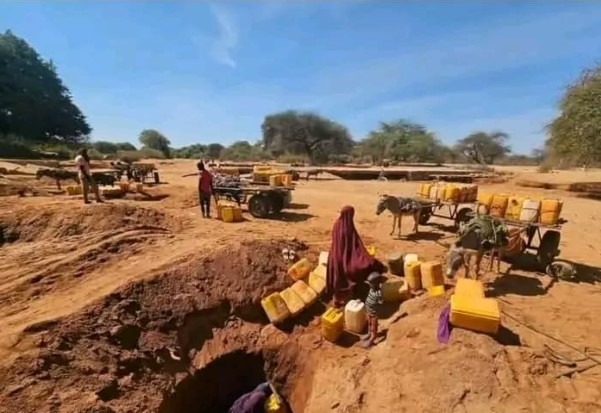
Residents of Modogashe, Isiolo North Constituency, Kenya, extracting water from deep hand-dug holes in a dry riverbed. Image source: Isiolo youth forum.
Kenya’s Hunger Safety Net Programme (HSNP) shows what a different approach can look like. Implemented by the National Disaster Management Authority, HSNP provides unconditional cash transfers in eight arid counties, including Isiolo, Turkana, Marsabit, Wajir, and Mandera. During drought periods, governments and partners have scaled up payments to help households buy food and basic goods instead of selling livestock at distress prices. Recent government communication shows continued drought-related transfers into early 2026. Cash matters because it meets people where they are. It does not ask households to attend training to qualify for help. It does not require waiting for a pilot to conclude. It gives families room to decide what they need most, whether food, water, medicine, or school costs. In this sense, HSNP shows how climate-linked support can protect dignity.
Yet, cash alone cannot carry adaptation. When drought deepens, the costs expand beyond food. Entire water systems fail under pressure. The pasture disappears. Disease spreads among weakened animals. Markets stop working normally because everyone is selling and few are buying. Marsabit’s own seasonal assessments describe how prolonged drought disrupted herd dynamics, incomes, and livestock health, with high mortality among cattle, sheep, and goats. These animals are the foundations of pastoral wealth. When they collapse, recovery is slow. This is where adaptation should become visible as infrastructure and services, not documents. Water is the clearest example. Everyone agrees it is the first line of defence in drylands. Still, too much climate adaptation funding settles for softer activities. Training sessions happen more easily than borehole maintenance. Awareness campaigns move faster than pipelines. Reports are easier to count than reliability. Climate finance, as it is currently structured, often rewards what can be delivered quickly rather than what must be sustained.
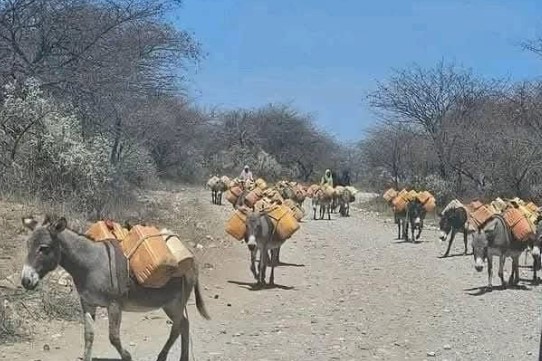
Pastoralist communities travel across a drought-stricken landscape in search of water points. Image source: Isiolo youth forum.
The consequences are familiar across Northern Kenya. Families walk further for water. Women and girls carry the heaviest burden. Hours are lost searching and queuing. That time comes from schooling, paid work, and rest. In drought years, this becomes a silent tax on women. Climate stress does not invent inequality. It deepens what already exists. In pastoral settings, gender norms shape who moves with livestock, who stays with children, who fetches water, and who speaks in local decisions. Drought intensifies these roles. The cost is paid in women’s bodies and girls’ futures.
Another part of the bill is paid through debt. At household level, families borrow to survive. At national level, drought response competes with debt repayments and other fiscal pressures. When public money is tight, long-term investment in water networks, health systems, and resilient schools is postponed again. Adaptation is then pushed back into projects because projects appear more fundable than services. That shift has consequences. Projects are temporary. Services are meant to endure. When a borehole breaks, there is no project cycle to wait for. When pasture fails, there is no logframe to appeal to. People need institutions that work in bad years as well as in good ones. This is why drought declarations keep repeating. Declaring drought a national disaster year after year points to more than bad weather. It points to a model of adaptation that has not yet become everyday protection.
Northern Kenya does not need more sympathy. It needs climate finance that builds public goods. Water systems that are maintained, not launched. Health services that are staffed, not visited. Schools that stay open, not closed by crisis. Early warning that triggers early action, not early reports. Kenya already has pieces of this. NDMA’s monitoring and scalable cash response show what is possible. The question is whether climate finance is allowed to become this kind of durable protection, or whether it will keep cycling through consultancies while families keep walking.
Climate finance is not charity. It is connected to a problem whose benefits were enjoyed elsewhere while the costs now fall heavily on places like Isiolo, Turkana, Marsabit, Wajir and Mandera. The people losing herds did not build the system that warmed the planet. Yet the system still treats their survival as a project.
I think again of the livestock death numbers and what they conceal. Each figure includes a household that planned for a different year, a different future. If adaptation keeps rewarding paperwork more than plumbing, the poorest will keep paying the highest price. And they will keep adapting, not because the system works, but because they have no other choice.

Hadija Bonaya is a development practitioner and Atlantic Fellow for Social and Economic Equity at the London School of Economics, where she is pursuing an MSc in Inequality and Social Science. Her work focuses on structural inequality, gender justice, education access, and climate vulnerability in marginalised communities in Northern Kenya. She previously served at Kenya’s National Cohesion and Integration Commission, working on peacebuilding, conflict mediation, and national public education programmes. Hadija is also the founder of BintiHope Foundation, which supports girls’ education and leadership. Her work bridges research, policy, and community action to advance equity and social justice.
Feature image: Zach Wolff on Unsplash